

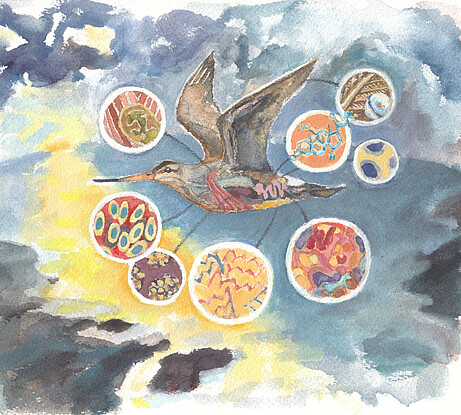
New frontiers in avian migration physiology
Bird migration is one of the most extreme physical challenges in the animal kingdom. Migratory birds are able to fly hundreds of kilometres, often nonstop, relying on a unique physiology that allows them to fuel their endurance flights, while simultaneously maintain energy balance and cope with oxidative stress. To study these mechanisms in detail, we use the island of Helgoland as a field site and the Common blackbird (Turdus merula) as one of our main model species. This unique setting allows us to combine natural migratory behaviour with accessible physiological measurements, and with the use of cutting-edge tracking technologies, directly link physiology with individuals’ migratory behaviour.
The ability to accomplish these migratory journeys depends on the coordination of multiple physiological systems. Therefore, our research explores how variation in telomeres, mitochondrial functioning, hormones or gut microbiome interact between them and relate to migratory performance and phenotypic plasticity. In addition to field-based studies on Helgoland, we also conduct controlled experiments in captivity on different songbird species such as the Eurasian blackcap (Sylvia atricapilla) or the Northern wheatear (Oenanthe oenanthe). These controlled conditions allow us to isolate specific mechanisms, test causal relationships and complement the complexity of observations made in the wild.
By integrating cutting-edge tracking technologies with physiological measurements our work aims to understand how birds adjust their physiology to meet the demands of migratory journeys. Ultimately, this approach reveals not only the remarkable flexibility of migratory birds but also how their physiology shapes survival and performance in rapidly changing environments.
Publications
Salmón P, Kärkkäinen T, Helm B (2026), New frontiers in avian physiology: what's migration got to do with it? Journal of Avian Biology 2026: e03628 doi: 10.1002/jav.03628
Baugh AT, Partecke J, Wellbrock N, Frias-Soler RC, Bairlein F, Hykollari A, Fusani L, Salmón P (2026) Migrant blackbirds (Turdus merula) on stopover have higher plasma PYY compared to residents: a validation and proof-of-concept. Hormones and Behavior 178: 105885 doi: 10.1016/j.yhbeh.2026.105885
Salmón P, Ellermann S, Wellbrock N, Frías-Soler R, Bairlein F, Liedvogel M (2026) Migratory Eurasian blackbirds have longer telomere length but similar mitochondrial density than resident conspecifics. Journal of Avian Biology 2026: e03547 doi: 10.1002/jav.03547