

Evolution of Lyme borreliosis causing bacteria (Borrelia)
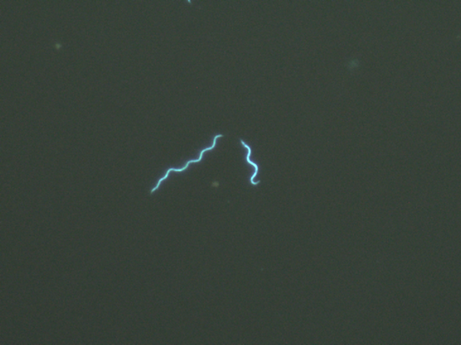
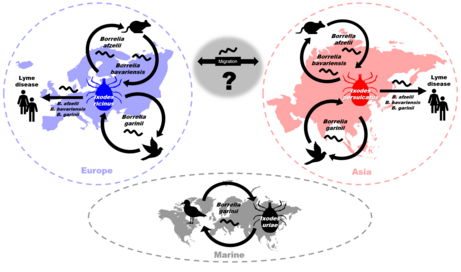
Lyme borreliosis (LB) is the most common vector-borne disease in the Northern hemisphere and is caused by specific species belonging to the Borrelia burgdorferi sensu lato complex. Borrelia are spirochete bacteria which have an obligate parasitic life-cycle transmitting through tick vectors (normally of the genus Ixodes) and various vertebrate hosts. These bacteria generally show a strict host association which is governed by interaction between Borrelia-encoded surface proteins and host immune proteins.Utilizing genomic data on three LB-causing Borrelia species (Borrelia afzelii, Borrelia bavariensis, Borrelia garinii), we aim to study the genetic basis of host and vector adaptation. In particular, we are interested in the impact of naturally occurring variation on human-disease manifestation as well as using population genetics tools to better understand the ecology of these bacteria across their Eurasian range (Collaboration with: Prof. Dr. Peter Kraiczy, Dr. Volker Fingerle, Dr. Gabriele Margos, Ms. Sabrina Hepner, and Dr. Anna Obiegala).
Using then established genetic and lab-based methodologies from our research, we further aim to understand how modifications to host immunity, such as immune downregulation in birds during migration, can influence how bird-associated Borrelia species (e.g., B. garinii, B. valaisiana) but also rodent-adapted species (B. afzelii)are able to arrive with migratory birds and potentially emerge in novel areas. To study this, we utilize the stopover island Helgoland as we can quantify local tick populations and the influx of ticks feeding on migratory birds.
Publications
Wülbern J, Windorfer L, Sato K, Nakao M, Hepner S, Margos G, Fingerle V, Kawabata H, Becker NS, Kraiczy P°, Rollins RE°(2024). Unprecedented genetic variability of PFam54 paralogs among Eurasian Lyme borreliosis-causing spirochetes. Ecology and Evolution, 14: e11397. https://doi.org/10.1002/ece3.11397
Hepner S, Kuleshov K, Tooming-Kunderud A, Alig N, Gofton A, Casjens S, Rollins RE, Dangel A, Mourkas E, Sheppard SK, Wieser A, Hübner J, Sing A, Fingerle V, Margos G (2023). A high-fidelity approach to assembling the complex Borrelia genome. BMC Genomics, 24: 401 (2023). https://doi.org/10.1186/s12864-023-09500-4
Rollins RE, Sato K, Nakao M, Tawfeeq MT, Herrera-Mesías F, Pereira RJ, Kovalev S, Margos G, Fingerle V, Kawabata H, Becker NS (2023). Out of Asia? Expansion of Eurasian Lyme borreliosis causing genospecies display unique evolutionary trajectories. Molecular Ecology, 32, 786-799. https://doi.org/10.1111/mec.16805
Rollins RE, Wülbern J, Röttgerding F, Nowak TA, Hepner S, Fingerle V, Margos G, Lin YP, Kraiczy P, Becker NS (2022). Utilizing Two Borrelia bavariensis Isolates Naturally Lacking the PFam54 Gene Array To Elucidate the Roles of PFam54-Encoded Proteins. Applied and Environmental Microbiology. 88(5): e0155521. https://doi.org/10.1128/aem.01555-21
Norte AC, Boyer PH, Castillo-Ramirez S, Chvostáč M, Brahami MO, Rollins RE, Woudenberg T, Didyk YM, Derdakova M, Núncio MS, Lopes de Carvalho I, Margos G, Fingerle V. The Population Structure of Borrelia lusitaniae Is Reflected by a Population Division of Its Ixodes Vector (2021). Microorganisms. 9(5):933. https://doi.org/10.3390/microorganisms9050933
Becker NS, Rollins RE, Nosenko K, Paulus A, Martin S, Krebs S, Takano A, Sato K, Kovalev SY, Kawabata H, Fingerle V, Margos G. High conservation combined with high plasticity: genomics and evolution of Borrelia bavariensis (2020). BMC Genomics 21, 702. https://doi.org/10.1186/s12864-020-07054-3
Hepner S, Fingerle V, Duscher GG, Felsberger G, Marosevic D, Rollins RE, Okeyo M, Sing A, Margos G (2020). Population structure of Borrelia turcica from Greece and Turkey. Infection, Genetics, and Evolution. 77:104050. https://doi.org/10.1016/j.meegid.2019.104050