

Understanding vagrancy
It has never been more important that we understand the inheritance and mechanism of long-distance migration, since migratory animals are particularly vulnerable to global changes. These mechanisms will impose fundamental constraints on the extent to which species will (or won't) respond to environmental change, and hence are an integral to our response to anthropogenic environmental alteration.
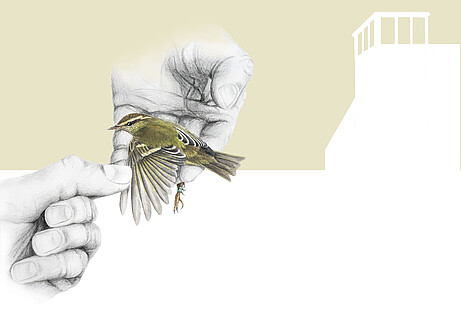
Studying the mechanisms of migration in situ is challenging, but we believe that vagrant animals present a unique opportunity to do so. Chief amongst such vagrants is the yellow-browed warbler, a 6 g songbird that typically migrates from Siberia to Southeast Asia but has become exponentially more common in Europe - 5,000 km from its next-nearest wintering site.
Studying these birds is challenging, since age ratios suggest that most of the birds overwintering in Europe are juveniles (and hence cannot be tracked back to their breeding sites with biologgers). However, the information stored within their genomes offers an alternative mechanism of determining their origins. By sequencing the small amount of genetic information contained within their feathers, and sequencing samples from across the breeding range, we can trace birds back to their geographic origins. By doing this for several different species, we hope to understand yellow-browed warbler vagrancy and, in turn, use this to understand the mechanisms of long-distance migration.