

Interactions between parasitism and avian migration
Parasitism is one of the most common biological relationships worldwide. Avian hosts support a wide variety and diversity of parasites, with some being highly specialized towards specific bird species. Our and other work has shown that interactions between avian hosts and parasites are modified through variation in avian behavior, such as migration, and life-history traits. We utilize two established systems, ticks/tick-borne pathogens and haemosporidian blood parasites, to study the impact of this variation and how bird specific variation in behavior or life-history modifies hypotheses surrounding the impact of these host-parasite interactions.
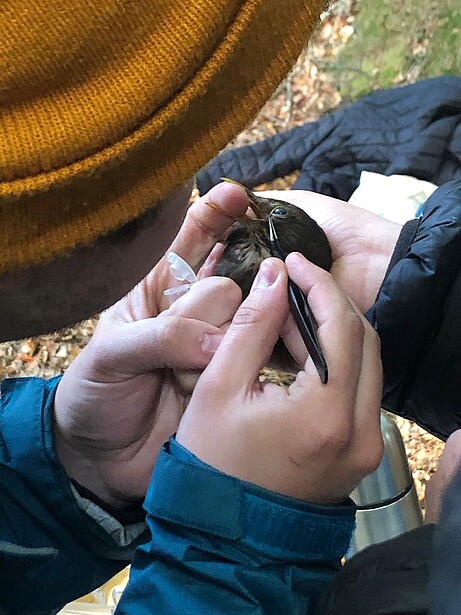
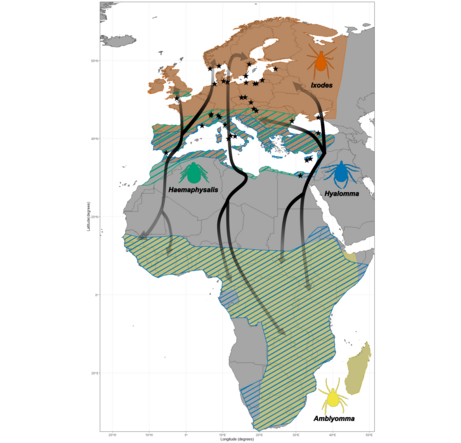
Through tick collection on breeding and migratory birds, we aim to understand how birds come into contact with questing ticks (breeding) and potentially influence the spread of ticks and tick-borne pathogens into novel areas (migratory). Focusing on the stopover island of Helgoland, we sample ticks from the island having confirmed four tick species to be present consistently over years (Ixodes ricinus, Haemaphysalis punctata, Ixodes uriae, Alectorobius maritimus) (Rollins et al., 2025). We pair this with sampling from local animals (sheep and house pets) through collaboration with island residents and sample ticks from the migratory birds caught at the institute’s Fanggarten. Here we aim to understand how variation in migratory behavior, such as timing or seasonality, influences the viability of ticks to survive in a novel location and what impact this could have on the emergence of tick-borne pathogens (focus placed on Borrelia burgdorferisensu lato, the causative agent of human Lyme borreliosis). We also work with local ringers to collect data on tick infestation of breeding birds at constant effort ringing sites (IMS), to determine the role specific bird species for tick populations and quantify changes over time in bird-tick interactions. If you are a ringer and would want to participate, feel free to send an email to Dr. Robert E. Rollins for more information.
Working within the established European robin and Eurasian blackcap systems of the institute, we molecularly characterize haemosporidian infection (Haemoproteus, Plasmodium, Leucocytozoon) in blood samples collected in relation to unraveling the genetic basis of migratory behavior in tracked individuals. We aim then to link infection back to variation in migratory behavior to understand the interactions and/or consequences of parasite infection on these birds. We aim then to link this back to variation in immunity to better understand the trade offs within avian systems in terms of tolerance and resistance.
Publications
Rollins RE, Dierschke J, Obiegala A, von Buttlar H, Chitimia-Dobler L, Liedvogel M (2025). Analysis of ticks and associated microorganisms collected on the island of Heligoland. Parasitology Research, 124(34). https://doi.org/10.1007/s00436-025-08478-0
Burnus L, Wynn J, Liedvogel M, Rollins RE(2024). Beware of hitchhiking ticks? Clarifying the variable roles of bird species in tick movement along migratory routes. Journal of Avian Biology, e03275. https://doi.org/10.1111/jav.03275
Rollins RE, Schaper S, Kahlhofer C, Frangoulidis D, Strauß AFT, Cardinale M, Springer A, Strube C, Bakkes DK, Becker NS, Chitimia-Dobler L (2021). Ticks (Acari: Ixodidae) on birds migrating to the island of Ponza, Italy, and the tick-borne pathogens they carry. Ticks and Tick-borne Disease. 12(1):101590. https://doi.org/10.1016/j.ttbdis.2020.101590
Core Team
- Prof. Dr. Miriam Liedvogel
- Dr. Robert Rollins
- Dr. Pablo Salmón
- Dr. Jochen Dierschke
- Dr. Joe Wynn